
Records
A record is a data structure that can store different types of related data.
For example, if we want to store information about a pupil, we might need:
- their name
- their age
Instead of storing these separately, we group them together in one structure called a record.
from dataclasses import dataclass

@dataclass
class Pupil:
    name: str = ""
    age: int = 0

new_pupil = Pupil()
new_pupil.name = "Rachel"
new_pupil.age = 16

print(new_pupil.name)
print(new_pupil.age)
# Import a tool that helps us create records
from dataclasses import dataclass

# Define a record structure called Pupil
@dataclass
class Pupil:
    # Field to store the pupil's name (text)
    name: str = ""

    # Field to store the pupil's age (whole number)
    age: int = 0


# Create a new Pupil record
new_pupil = Pupil()

# Store "Rachel" in the name field of the record
new_pupil.name = "Rachel"

# Store 16 in the age field of the record
new_pupil.age = 16

# Display the value stored in the name field
print(new_pupil.name)

# Display the value stored in the age field
print(new_pupil.age)
Array of Records
An array of records is a data structure where each array element stores a record.
To access the data in an array of records you must specify the array name, index and record field.
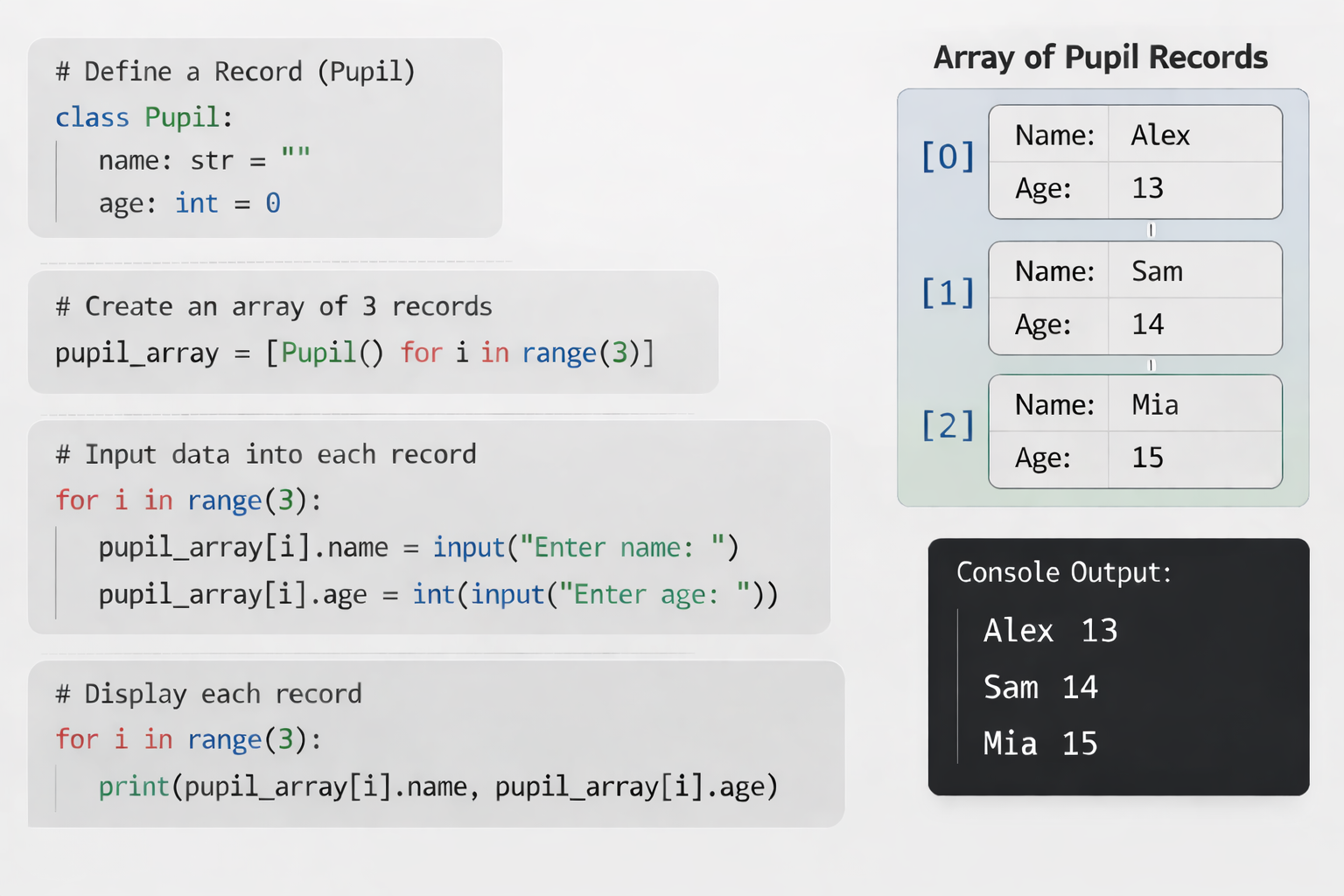
from dataclasses import dataclass

@dataclass
class Pupil:
    name: str = ""
    age: int = 0

# Create an array of records
pupil_array = [Pupil() for i in range(3)]

# Input data into array of records
for i in range(3):
    pupil_array[i].name = input("Enter name: ")
    pupil_array[i].age = int(input("Enter age: "))

# Display array of records
for i in range(3):
    print(pupil_array[i].name, pupil_array[i].age)
from dataclasses import dataclass

@dataclass
class Pupil:
    name: str = ""
    age: int = 0

def read_data():
    # Create an array of records
    pupils = [Pupil() for i in range(3)]
    file = open("pupils.txt", "r")
    for i in range(3):
        pupils[i].name, pupils[i].age = file.readline().strip().split(",")
        pupils[i].age = int(pupils[i].age)
    file.close()
    return pupils

def display_data(pupils):
    # Display array of records
    for i in range(3):
        print(pupils[i].name, pupils[i].age)

# Main
pupils = read_data()
display_data(pupils)
from dataclasses import dataclass

@dataclass
class Pupil:
    name: str = ""
    age: int = 0

def read_data():
    pupils = [Pupil() for i in range(3)]
    file = open("pupils.txt", "r")
    for i in range(3):
        pupils[i].name, pupils[i].age = file.readline().strip().split(",")
        pupils[i].age = int(pupils[i].age)
    file.close()
    return pupils

def find_oldest(pupils):
    oldest = pupils[0].age
    for i in range(1, len(pupils)):
        if pupils[i].age > oldest:
            oldest = pupils[i].age
    print("The oldest pupil is", oldest, "years old.")

# Main
pupils = read_data()
find_oldest(pupils)
from dataclasses import dataclass

@dataclass
class Pupil:
    name: str = ""
    age: int = 0

def read_data():
    pupils = [Pupil() for i in range(3)]
    file = open("pupils.txt", "r")
    for i in range(3):
        pupils[i].name, pupils[i].age = file.readline().strip().split(",")
        pupils[i].age = int(pupils[i].age)
    file.close()
    return pupils

def count_teens(pupils):
    num_teens = 0
    for i in range(len(pupils)):
        if pupils[i].age >= 13:
            num_teens = num_teens + 1
    return num_teens

def write_data(num_teens):
    file = open("teenagers.txt", "w")
    file.write("There are " + str(num_teens) + " teenagers.")
    file.close()

# Main
pupils = read_data()
num_teens = count_teens(pupils)
write_data(num_teens)